


Cloud Security Posture
- Cloud
- AWS · Azure · Exoscale · Scaleway
- CDN · WAF
- Akamai · Cloudflare
- Checked against
- Best practice · reachability
- Accounts
- Declared and shadow
Cloud Posture
best practice first, then real exposure
Simulated estate · checked against best practice, then against real exposure
Cloud posture tools drown you in misconfigurations without telling you which ones are reachable.
Panop checks your cloud, CDN, and WAF configurations, then reconciles every finding against your real exposure. A misconfiguration that attackers can reach is a priority. One they can't is noise. Panop knows the difference.
Posture for every account, even the ones you didn't declare
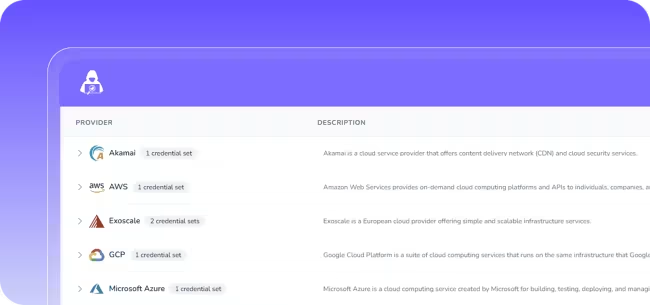
Panop scores the posture of each cloud account it discovers, across Azure, AWS, and Exoscale. Shadow accounts don't escape scoring: the moment one is found, its configuration is assessed like the rest.
Catch the misconfigurations that matter
Public buckets, open security groups, over-permissive roles, unencrypted stores, Panop checks your cloud configurations continuously and maps every finding to the CIS benchmarks and the NIS2 and DORA controls your auditors ask about.
See through your CDN and WAF
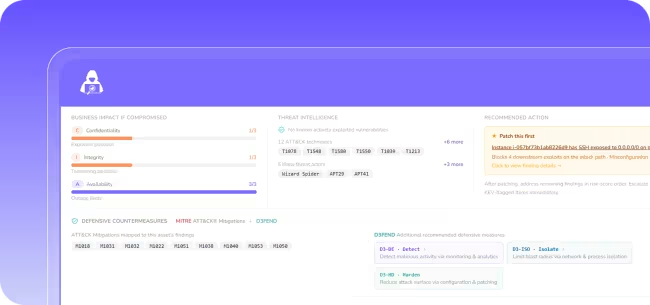
A WAF only protects the traffic that goes through it. Panop discovers your CDN and WAF configurations, checks which rules actually cover which paths, and finds the origins still reachable directly, the bypass attackers try first.
Watch posture drift as it happens
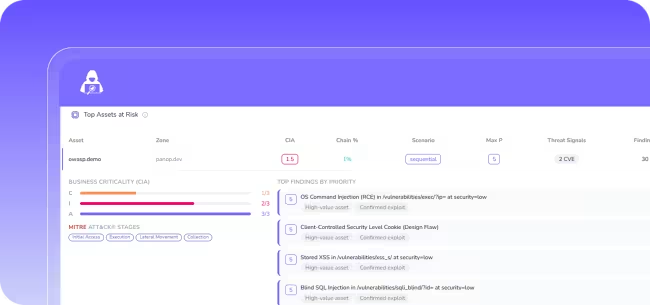
Cloud configurations change daily; audits happen yearly. Panop monitors continuously, so a bucket made public on Tuesday is a finding on Tuesday, with the fix verified and your score restored the moment it lands.
Posture that knows what is actually reachable.
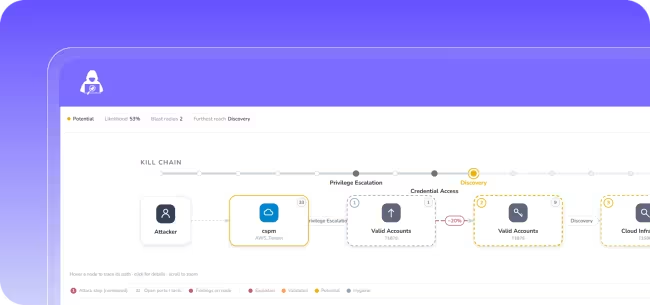
A misconfiguration rule firing tells you a setting is wrong, not that anyone can get to it. Panop assesses every cloud account it discovers, then reconciles each finding against the exposure it has independently mapped and validated from the outside. A gap an attacker can reach becomes a priority; one buried behind controls that hold becomes context.
- Cloud accounts
- CDN and WAF config
- Identity policies
- Configuration baselines
- Reachability analysis
- Drift detection
- Reachable gaps
- Per-account posture scores
- Verified drift fixes
Built to separate reachable gaps from noise
Three posture behaviours that turn a wall of misconfigurations into a ranked set of reachable ones.
Each cloud account is scored as it is discovered, including the shadow accounts opened outside procurement, which are assessed the moment they are found.
Explore solutions by use case
- Risk Prioritisation Know the 10 things to fix today.
- AI-SPM Every AI asset, known and shadow.
- Autonomous Pentest Continuous validation, not annual exercises.
- Cloud Security Private Cloud under control.
- Compliance NIS2. DORA. EU AI Act. Always audit-ready.
- Supplier Security Managing Third-Party & Supplier Risk
Frequently asked questions
The questions cloud and platform teams ask most about posture management in Panop.
How is this different from a standalone CSPM tool?

A conventional CSPM assesses configuration against a baseline and reports everything that deviates. Panop adds the half that decides priority, reconciling each deviation against the attack surface it has independently discovered and validated from the outside. The finding you get is not just a rule that fired but a statement about whether the gap is reachable.
Which cloud providers are covered?
Posture assessment runs across the major providers, including Azure, AWS, GCP, OVHcloud and Exoscale. Coverage follows discovery rather than a connected-account list, so an account opened outside procurement is scored as soon as it is found instead of waiting to be onboarded.
Does Panop check CDN and WAF configuration too?
Yes, because a WAF only protects the traffic that passes through it. Panop discovers your CDN and WAF configuration, checks which rules actually apply to which paths, and identifies origins that remain reachable directly. A protected application with an unprotected origin is a common and highly exploitable pattern that account-level posture checks miss.
How does posture data support an audit?
Findings are mapped to the CIS benchmarks and to the NIS2 and DORA controls they affect, and because assessment runs continuously the record accumulates as operations happen. That means dated evidence of what was checked and when, current on the day it is requested rather than reconstructed before a review.