


Validated exposure. Delivered where your team acts.
- Access
- REST API · CLI
- Alerts
- Alert Manager
- Native
- SIEM, CMDB, ticketing
- Direction
- Inbound and outbound
Finding Routing
one policy, every destination
Simulated finding · define the policy once, every destination updates itself
Panop continuously discovers and validates what's genuinely exploitable across your attack surface.
Through its REST API, CLI, Alert Manager, and native SIEM, CMDB and ticketing integrations, prioritised risk flows straight to the teams and tools that act on it.
Exposure intelligence that stays in a console isn't intelligence yet.
Most exposure platforms end at the dashboard: findings pile up, and turning them into a ticket, a playbook or a SIEM event stays manual. Meanwhile AI has compressed exploit development from weeks to hours. Intelligence that waits for someone to log in, export and re-enter it arrives too late to matter.
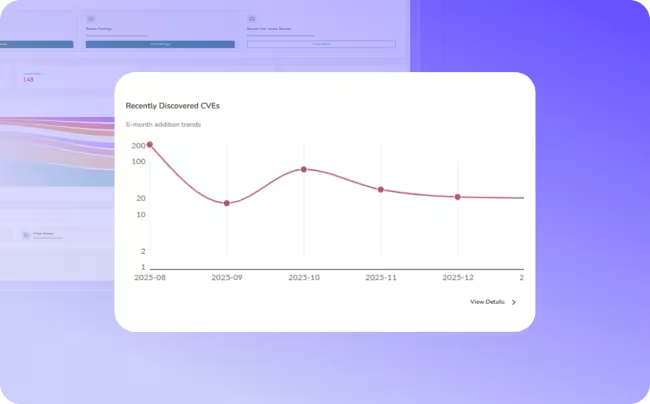
The advantage goes to teams whose exposure intelligence moves at machine speed.
Operationalised, exploitable risk gets fixed while it's still a finding, routed automatically to its owner, in the tool they already use, with validation context attached. Without integration, analysts re-key findings between systems while validated risk waits in a queue and the exploit window closes.
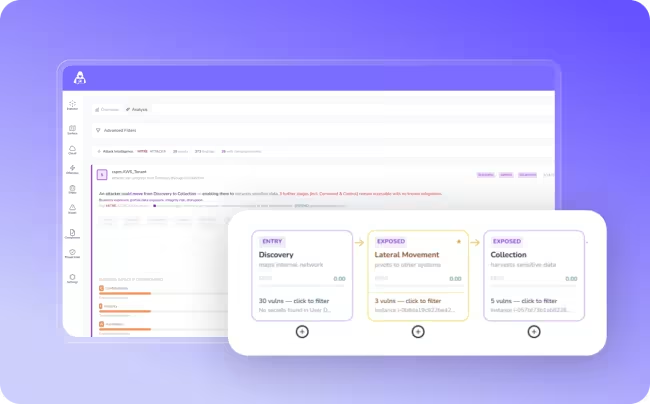
One continuous flow: from discovery to remediation.
Panop doesn't stop at theoretical vulnerabilities.
Panop validates what's genuinely exploitable, prioritises it by business impact, and routes it automatically , a ticket for the asset owner, context for your SIEM, updates for your CMDB, evidence for your auditors. Define the policy once; only the decisions that need human judgment reach a human.
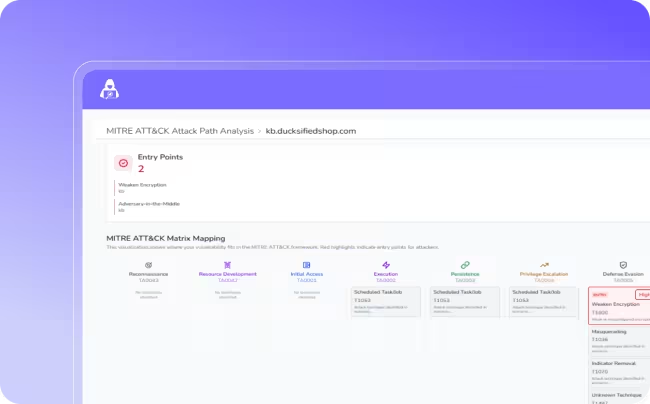
A loop that closes inside your own stack.
Panop integrations run in both directions. Asset ownership and business context flow in to sharpen how exposure is ranked, and validated risk flows back out to the system that owns the fix. Nobody re-keys a finding between consoles, so the work starts while the exposure is still a finding rather than an incident.
- CMDB ownership
- Business criticality
- Cloud and CI/CD data
- Context ingestion
- Policy-based routing
- Bidirectional sync
- Owner tickets
- SIEM events and alerts
- Audit-ready evidence
Built to operationalise cyber exposure at scale
Three ways in, together they close the loop between what Panop finds and what your teams fix.
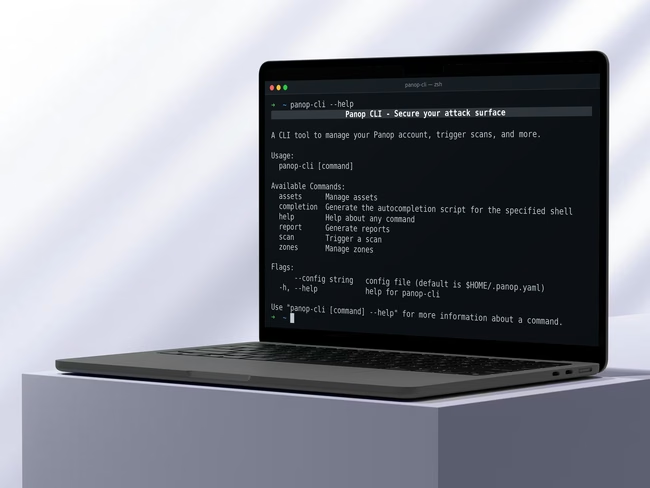
Everything Panop knows, assets, validated exposures, priorities, reports, available over a powerful REST API, in both directions.


Explore solutions by use case
- Risk Prioritisation Know the 10 things to fix today.
- AI-SPM Every AI asset, known and shadow.
- Autonomous Pentest Continuous validation, not annual exercises.
- Cloud Security Private Cloud under control.
- Compliance NIS2. DORA. EU AI Act. Always audit-ready.
- Supplier Security Managing Third-Party & Supplier Risk
Frequently asked questions
The questions platform and security engineers ask most about connecting Panop to an existing stack.
What can the REST API and CLI actually reach?

Everything Panop knows, in both directions: assets, validated exposures, priorities and reports. The API is the same surface the product itself uses, so anything visible in the console can be read or driven programmatically. The CLI wraps it for the terminal and for CI/CD, which is how exposure checks become part of a release rather than a review after one.
Do integrations only push data out?
No, and the inbound direction is what makes prioritisation accurate. Ownership from your CMDB, criticality ratings and business context flow into Panop and change how validated findings are ranked. Without that, a platform can tell you a finding is exploitable but not whether it sits on a system that matters to your business.
How does Panop decide what reaches a human?
Through the Alert Manager, which escalates on policy rather than on volume. You define once what deserves attention, and only findings meeting that bar are raised, with exploitability context attached. Everything else is routed to its owner as a ticket or synced to the relevant system without interrupting anyone.
What if a tool we use is not supported natively?
Native connectors cover the common SIEM, CMDB and ticketing destinations, and the REST API covers the rest. Because the API exposes the full object model rather than a webhook subset, an unsupported destination is an integration to write rather than a limit on what data you can get out.