Risk Prioritisation
Know the 10 things to fix today.
Product
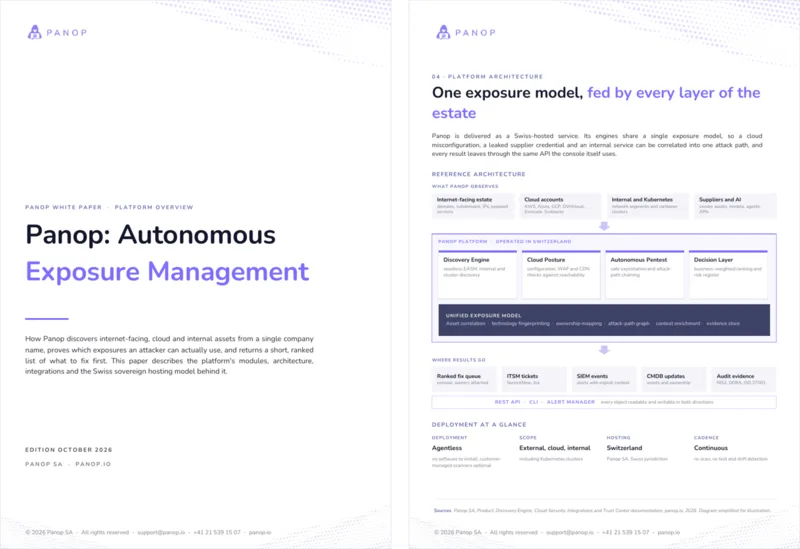
Panop continuously discovers, validates and prioritises exposure across modern environments, helping security teams reduce noise, focus faster and act on what truly matters.
Most exposure platforms rely on generic scans, fragmented signals and theoretical findings, generating massive amounts of noise for already overwhelmed security teams. Panop takes a different approach: targeted, continuous testing designed to validate what is actually exploitable in your environment.
Panop continuously maps exposed systems, identifies underlying services and technologies, then dynamically launches targeted tests based on the real environment detected.
Instead of blindly running exhaustive generic scans, Panop focuses on targeted validations, reducing false positives, limiting infrastructure pressure and accelerating remediation workflows.

Panop combines active testing results with business and operational context to prioritise what truly matters.
Critical assets, sensitive environments or brand-impacting systems can all be weighted differently, transforming technical findings into actionable priorities.

Panop doesn't stop at theoretical vulnerabilities.
Through fingerprinting, exploit validation and targeted testing logic, the platform helps teams distinguish potentially vulnerable systems from exposures that are genuinely exploitable in real operational conditions.

Panop is built for the full exposure lifecycle, a continuous, proactive solution that moves with the full lifecycle of risk: discovering attack surface, assessing posture, validating real-world exploitability, and driving remediation.The result: faster decisions, sharper context, and exposure that never gets the chance to mature.
Built to help security teams identify, validate, prioritise, and remediate exposure across complex environments. Designed for modern infrastructures where visibility alone is no longer enough.
Connect exposure data, threat intelligence and attack paths into one operational view.


Know the 10 things to fix today.
Every AI asset, known and shadow.
Continuous validation, not annual exercises.
Private Cloud under control.
NIS2. DORA. EU AI Act. Always audit-ready.
Managing Third-Party & Supplier Risk
Explore the most frequently asked questions about how Panop works and integrates into your security ecosystem.
Panop continuously discovers every asset across cloud, internet-facing, third-party and internal environments, then actively tests them to confirm which exposures are genuinely exploitable. Validated findings are weighted by business and operational context and returned as a ranked remediation queue with evidence attached. The output is a short list of what to fix today, not another stream of alerts to triage.
Panop runs targeted tests against the services and technologies it actually detected, rather than exhaustive generic scans, which produces fewer findings to begin with. Each finding is then validated to confirm whether it is genuinely exploitable, so theoretical issues are separated from demonstrated access before triage. What reaches an analyst is confirmed, ranked and evidenced, not a raw scanner export.
The Decision Layer is the stage where Panop turns validated exposure into an ordered set of actions. It takes confirmed findings from active testing, combines them with business and operational context, and produces a ranked remediation queue with owners attached. It is what separates Panop from a scanner — the output is a decision about what to do next, not an inventory of everything found.
Panop generates compliance evidence as a by-product of continuous monitoring rather than as a separate reporting exercise. Each validated finding is linked to the NIS2, DORA, ISO 27001 or EU AI Act control it affects, and dated records of what was tested and found accumulate as operations run. The audit trail is current on the day it is requested, not assembled in the weeks before a review.