





Security built for enterprise environments
Learn how Panop approaches platform security, privacy, compliance and operational resilience through documented controls and governance practices.


Maturity Model
NIST CSF 2.0 · current profile against target
Every function is scored from live evidence, not a questionnaire, so the gap to target moves as the estate does.
Modern infrastructures evolve continuously, while audits and reports remain largely static. The challenge is no longer collecting evidence, but keeping it aligned with operational reality.
Frameworks now require ongoing proof, not snapshots.
Security posture must reflect real-world exposure at all times.
Auditors expect continuous, exportable evidence.
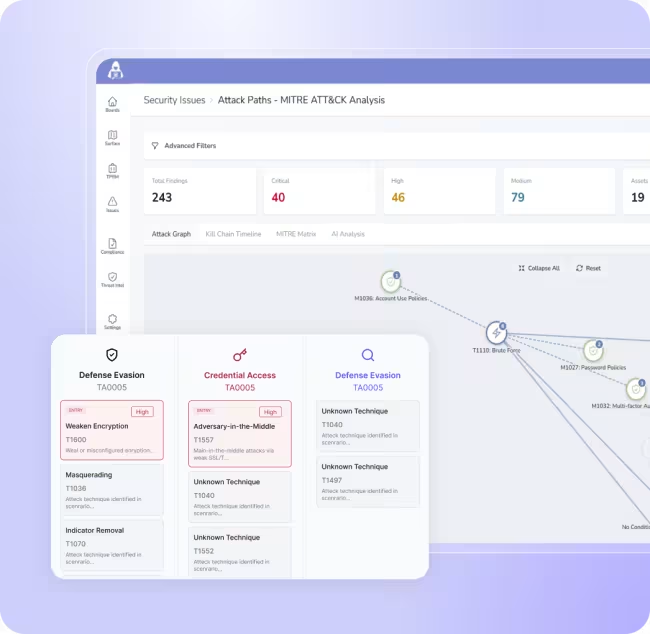
Panop continuously performs targeted security testing across exposed environments, generating technical findings, exploit validation and exportable reports aligned with operational and regulatory expectations.
Instead of relying on outdated assessments, teams gain access to continuously refreshed evidence, with actionable data updated in near real time.

Panop helps organisations generate exportable reports, map findings against security frameworks and maintain continuously updated visibility across infrastructures, services and exposed systems.
Real-time insight across infrastructures and exposed systems.
Evidence ready to share with auditors and stakeholders.
Map findings against NIS2, DORA and PCI requirements.
Continuous monitoring and regular security validation requirements for critical organisations.
Operational resilience requirements for financial and regulated environments.
Continuous infrastructure testing and visibility for payment environments
Learn how Panop approaches platform security, privacy, compliance and operational resilience through documented controls and governance practices.
Explore the most frequently asked questions about how Panop works and integrates into your security ecosystem.
Panop generates compliance evidence as a by-product of continuous monitoring rather than as a separate reporting exercise. Each validated finding is linked to the NIS2, DORA, ISO 27001 or EU AI Act control it affects, and dated records of what was tested and found accumulate as operations run. The audit trail is current on the day it is requested, not assembled in the weeks before a review.
Panop generates evidence across four groups. Security frameworks and standards: ISO/IEC 27001:2022, 27017:2015 and 27018:2019, NIST and CSA CCM. Regulatory requirements: PCI DSS 4.0, NIS2, DORA, GDPR, FedRAMP and FINMA. Best practices and benchmarks: OWASP Top 10 and CIS benchmarks for AWS, Azure, GCP and M365. Plus organisation-specific policies and tailored control frameworks.
Yes. Panop produces dated, attributable records of what was tested, what was found and what was remediated, exportable for audit, compliance and internal review. Because the same validation data maps to several frameworks, one evidence set can be reused across NIS2, DORA and ISO 27001 reporting instead of rebuilding a separate pack for each auditor. Scope gaps surface before an auditor finds them.
Panop re-tests controls whenever the underlying infrastructure changes, so drift is flagged between audit cycles rather than discovered at the next review. Continuous discovery keeps the asset inventory current as environments change, and continuous validation keeps the remediation queue ordered by what is actually reachable. Teams therefore work from a picture of the estate as it is now, not as it was at the last scan.
Customer exposure data is hosted in Switzerland. Panop SA is a Swiss company. Those are two different facts (residency and jurisdiction), and European tenders now score them separately. The operational scorecard is Digital sovereignty for security teams; the longer framework is the working paper.
Understand which risks actually matter and how to act on them.
